Seidel aberrations surface by surface: correction and tension in Caldwell’s KrF lens
The third order (Seidel) aberrations of a centred system are sums over its surfaces. Every surface adds its own spherical aberration \(S_I\), coma \(S_{II}\), astigmatism \(S_{III}\), Petzval curvature \(S_{IV}\) and distortion \(S_V\), computed from the paraxial marginal ray (height \(y\), refraction invariant \(A = n i\)) and the paraxial chief ray (\(\bar y\), \(\bar A = n \bar i\)) (Welford):
plus terms \(8 a_4 \Delta n\) times \(y^4\), \(y^3\bar y\), … for the departure of a conic or asphere from its vertex sphere. The primary colours are \(C_I = A y\,\Delta(\delta n/n)\) (axial) and \(C_{II} = \bar A y\,\Delta(\delta n/n)\) (lateral). Only the sums are properties of the lens. The single terms describe how the correction is shared between the surfaces. A well corrected lens has small sums. They can be small because every term is small (a relaxed design) or because large terms of opposite sign cancel (a tense design). Tense designs are sensitive to manufacturing and assembly errors, because an error in one surface upsets a large term that nothing else balances any more.
This notebook takes Caldwell’s all fused silica KrF projection lens
(raytrace.caldwell_krf_lens(): 21 elements, NA 0.56, 4x, 1 m, telecentric on
both sides) and
collects its first order data: total power, powers of the surfaces and elements, the share of each surface in the power, the Petzval sum and the third order image surfaces (
System.power(),surface_powers(),power_contributions(),elements(),element_powers(),third_order()),plots the five Seidel terms surface by surface (
System.seidel()) and explains which surfaces and groups introduce and which compensate each aberration,follows the running sums through the lens,
compares the Seidel sums with the real ray wavefront (third against higher orders),
quantifies the tension of the correction and shows what it costs, with element decentres traced with real rays,
looks at the primary colour (
System.chromatic_seidel()), which a lens made of one glass cannot correct.
import time

import numpy as np
import matplotlib.pyplot as plt

from pyoptics import raytrace as rt

plt.rcParams.update({"figure.dpi": 80, "font.size": 11, "figure.facecolor": "white",
                     "axes.facecolor": "#fcfcfb", "savefig.facecolor": "white",
                     "axes.grid": True, "grid.color": "0.88", "grid.linewidth": 0.6,
                     "axes.axisbelow": True, "axes.spines.top": False, "axes.spines.right": False})
t_start = time.time()

lens = rt.caldwell_krf_lens()
WL = lens.wavelength
p = lens.paraxial()
sd = lens.seidel()
els = lens.elements()
phi_el = lens.element_powers()
n_surf = len(lens.surfaces)
1. First order: power, Petzval sum and the five groups
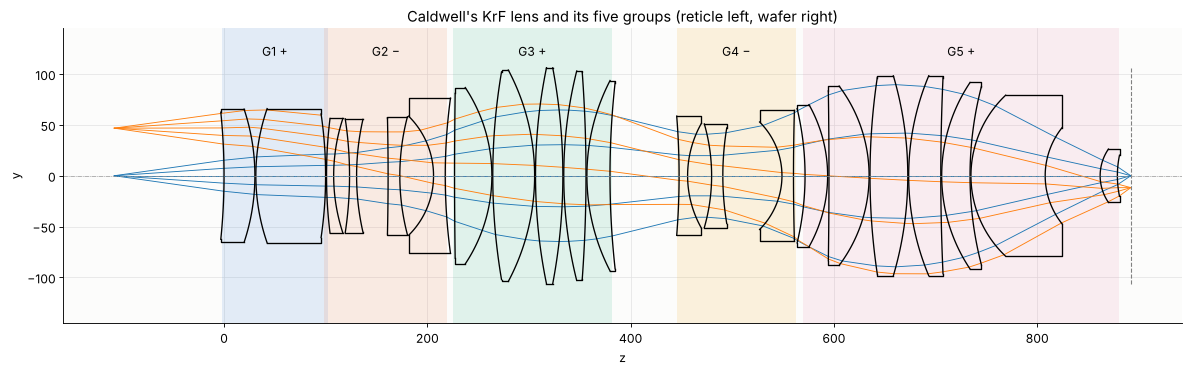
The lens has the classical form of a lithography lens: positive groups where the marginal ray is high (bulges) and negative groups where it is low (waists). The listing gives every element with its focal length in air and the marginal and chief ray heights at its first surface.
ym, yc = p.marginal[:, 0], p.chief[:, 0]
print(f"power of the lens   {lens.power():.6f} 1/mm  (efl {p.efl:.1f} mm, magnification {p.magnification:.4f}, NA {p.na:.3f})")
print(f"Lagrange invariant  H = {p.lagrange:.4f} mm, stop at surface {lens.stop_index + 1}")
print(f"sum of the surface power contributions y_i*phi_i/y_1: {lens.power_contributions().sum():.6f} 1/mm")
print()
print(" el  surfaces   f [mm]    y [mm]  ybar [mm]")
for k, ((a, b), f) in enumerate(zip(els, phi_el)):
    print(f"{k + 1:3d}   {a + 1:2d}-{b + 1:2d}  {1/f:8.0f}  {ym[a]:8.1f}  {yc[a]:8.1f}")
power of the lens   0.000467 1/mm  (efl 2139.5 mm, magnification -0.2500, NA 0.536)
Lagrange invariant  H = -6.2702 mm, stop at surface 30
sum of the surface power contributions y_i*phi_i/y_1: 0.000467 1/mm

 el  surfaces   f [mm]    y [mm]  ybar [mm]
  1    1- 2       598      14.5      46.3
  2    3- 4       278      17.5      46.9
  3    5- 6      -585      20.2      37.6
  4    7- 8      -293      21.4      33.4
  5    9-10      -414      26.2      30.4
  6   11-12      -141      34.3      29.9
  7   13-14       301      41.7      33.3
  8   15-16       326      52.9      38.4
  9   17-18       544      59.4      39.8
 10   19-20       642      60.2      38.4
 11   21-22       524      58.9      35.9
 12   23-24      -180      40.3      15.7
 13   25-26      -220      39.2      10.6
 14   27-28      -142      50.4       3.1
 15   29-30       535      60.4       1.3
 16   31-32       295      70.4      -0.1
 17   33-34       452      81.0      -2.5
 18   35-36       566      82.3      -4.6
 19   37-38       584      77.4      -5.9
 20   39-40     -1866      68.8      -6.9
 21   41-42       154      13.5     -12.3
By the signs of the element powers the lens splits into five groups:
group |
elements |
surfaces |
powers |
role |
|---|---|---|---|---|
G1 |
1–2 |
1–4 |
+ |
front field group, large \(\bar y\): telecentricity on the reticle side, distortion |
G2 |
3–6 |
5–12 |
− |
first waist |
G3 |
7–11 |
13–22 |
+ |
first bulge |
G4 |
12–14 |
23–28 |
− |
second waist |
G5 |
15–21 |
29–42 |
+ (20: weak −) |
aperture group with the stop (surface 30) and the wafer side |
GROUPS = [("G1 +", 0, 1), ("G2 −", 2, 5), ("G3 +", 6, 10), ("G4 −", 11, 13), ("G5 +", 14, 20)]
COLORS = ["#2a78d6", "#eb6834", "#1baf7a", "#eda100", "#e87ba4"]
surf_group = np.zeros(n_surf, dtype=int)
for g, (_, e0, e1) in enumerate(GROUPS):
    surf_group[els[e0][0]:els[e1][1] + 1] = g
surf_color = [COLORS[g] for g in surf_group]
idx = np.arange(1, n_surf + 1)

fig, ax = plt.subplots(figsize=(15, 4.8))
lens.draw(ax, fields=[0.0, lens.max_field], n_rays=5)
z0 = lens.vertex_z
for g, (name, e0, e1) in enumerate(GROUPS):
    a, b = els[e0][0], els[e1][1]
    ax.axvspan(z0[a] - 2, z0[b] + 2, color=COLORS[g], alpha=0.12, lw=0)
    ax.text((z0[a] + z0[b])/2, 118, name, ha="center", fontsize=11)
ax.set_title("Caldwell's KrF lens and its five groups (reticle left, wafer right)")
fig.tight_layout()
Power against Petzval sum
A surface contributes \(y_i\varphi_i/y_1\) to the power of the lens but \(\varphi_i/(n n')\) to the Petzval sum, independent of the ray height (Petzval’s theorem). That is the reason for the waists: a negative element where the marginal ray is low costs little power, but subtracts its full Petzval contribution. Summed over the elements, the positive groups provide the power, and the waists cancel their Petzval curvature:
contrib = lens.power_contributions()
petz = lens.surface_powers()/(lens.n*lens.sigma)[:-1]/(lens.n*lens.sigma)[1:]
el_contrib = np.array([contrib[a:b + 1].sum() for a, b in els])
el_petz = np.array([petz[a:b + 1].sum() for a, b in els])
el_color = [COLORS[surf_group[a]] for a, _ in els]
t3 = lens.third_order()

fig, axes = plt.subplots(1, 2, figsize=(15, 4.2), sharex=True)
e_idx = np.arange(1, len(els) + 1)
axes[0].bar(e_idx, 1e3*el_contrib, color=el_color, width=0.75)
axes[0].set_title(f"share in the power  y·φ/y₁  (sum {1e3*lens.power():.3f} /m)")
axes[1].bar(e_idx, 1e3*el_petz, color=el_color, width=0.75)
axes[1].set_title(f"Petzval contribution  Σφ/(n n')  (sum {1e3*t3.petzval_sum:.4f} /m)")
for ax in axes:
    ax.set_xlabel("element")
    ax.set_ylabel("1/m")
    ax.axhline(0, color="0.3", lw=0.8)
    ax.set_xticks(e_idx)
handles = [plt.Rectangle((0, 0), 1, 1, color=c) for c in COLORS]
axes[0].legend(handles, [g[0] for g in GROUPS], ncol=5, fontsize=9, loc="lower left")
fig.tight_layout()

print(f"positive elements: power share {1e3*el_contrib[phi_el > 0].sum():+.2f} /m, Petzval {1e3*el_petz[phi_el > 0].sum():+.2f} /m")
print(f"negative elements: power share {1e3*el_contrib[phi_el < 0].sum():+.2f} /m, Petzval {1e3*el_petz[phi_el < 0].sum():+.2f} /m")
print(f"Petzval radius {t3.petzval_radius/1e3:.0f} m, sagittal {t3.sagittal_radius/1e3:.0f} m, "
      f"tangential {t3.tangential_radius/1e3:.0f} m, medial {t3.medial_radius/1e3:.0f} m")
print(f"over the image field (radius {abs(p.image_height):.2f} mm) the medial surface departs by "
      f"{1e6*p.image_height**2/(2*t3.medial_radius):.0f} nm from the plane")
print(f"third order distortion at the edge of the field: {1e6*t3.distortion:.1f} ppm = "
      f"{1e6*t3.distortion*abs(p.image_height):.0f} nm")
positive elements: power share +13.77 /m, Petzval +22.39 /m
negative elements: power share -13.30 /m, Petzval -22.38 /m
Petzval radius -205 m, sagittal -81 m, tangential -36 m, medial -50 m
over the image field (radius 11.70 mm) the medial surface departs by -1362 nm from the plane
third order distortion at the edge of the field: -14.2 ppm = -166 nm
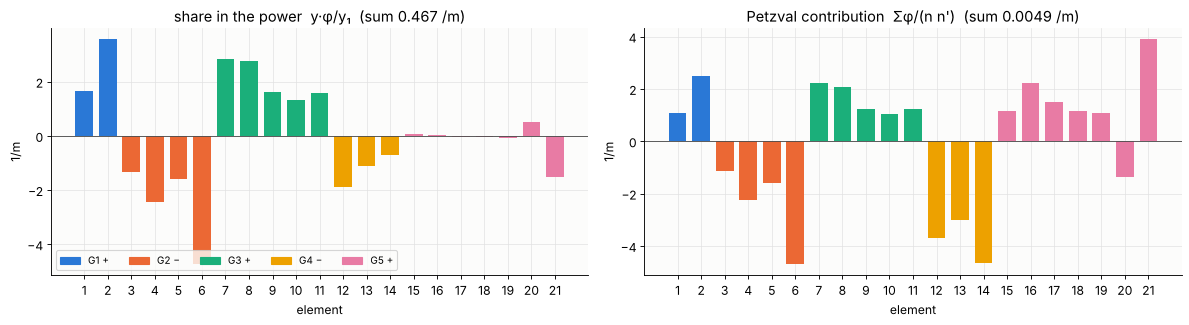
The negative elements take away only a fraction of the power of the positive ones, but nearly all of their Petzval sum. What remains is a Petzval radius of about 200 m. The astigmatism (section 2) bends the sagittal and tangential surfaces more strongly (81 m and 36 m). In third order, the medial surface departs by 1.4 µm from the plane at the edge of the field, more than the depth of focus. The real lens balances this against higher order field curvature (section 4).
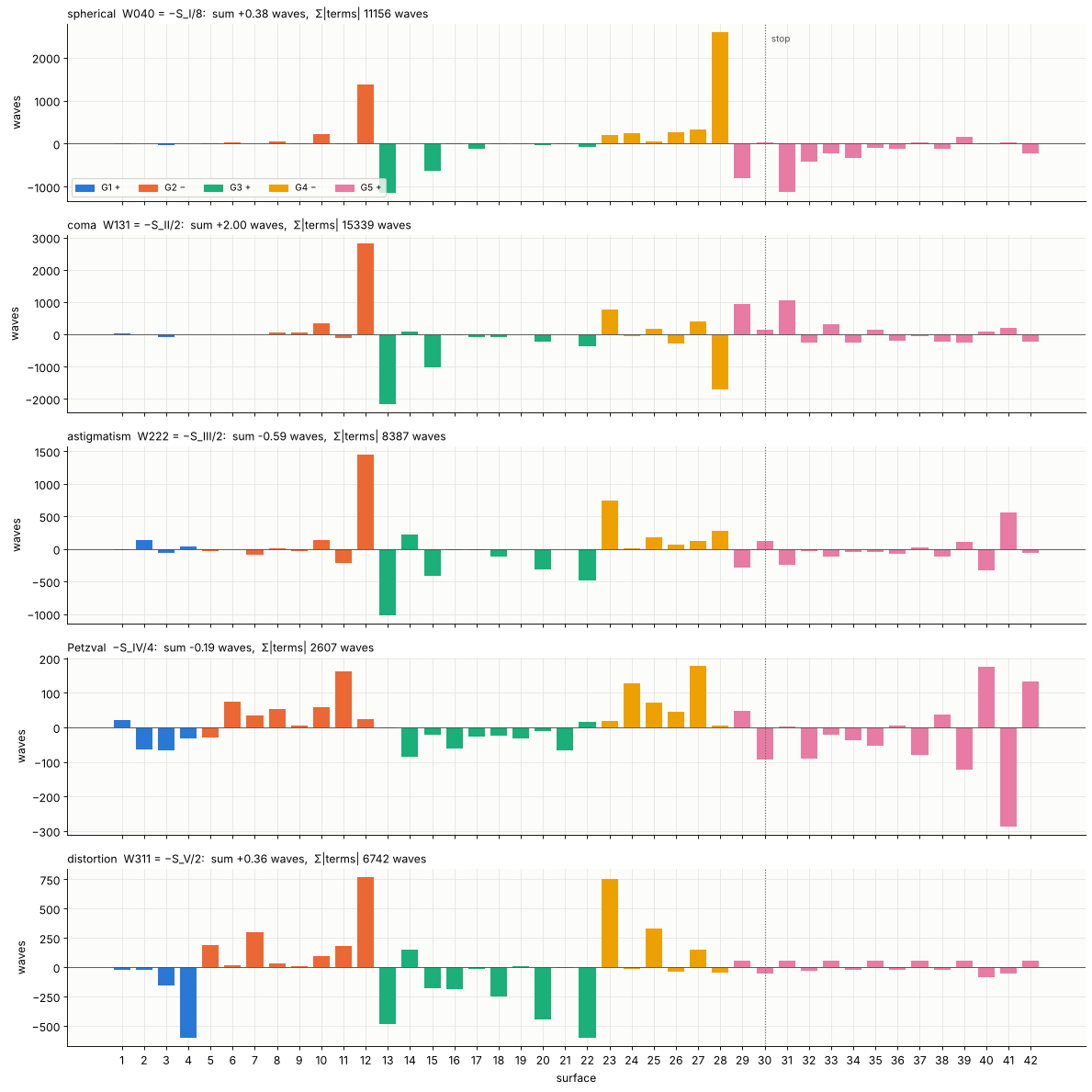
2. The Seidel terms surface by surface
System.seidel() returns the contributions S (one row per surface) and,
in W, the same in waves as the wavefront coefficients
\(W_{040} = -S_I/8\), \(W_{131} = -S_{II}/2\), \(W_{222} = -S_{III}/2\),
\(W_{220} = -(S_{III} + S_{IV})/4\), \(W_{311} = -S_V/2\) (full aperture, full
field; negative \(W_{040}\) = undercorrected, see the conventions of
raytrace). The Petzval term is plotted as \(-S_{IV}/4\) in waves, the
curvature part of \(W_{220}\).
names = ["spherical  W040 = −S_I/8", "coma  W131 = −S_II/2", "astigmatism  W222 = −S_III/2",
         "Petzval  −S_IV/4", "distortion  W311 = −S_V/2"]
k_w = np.array([-1/8, -1/2, -1/2, -1/4, -1/2])/WL
Wsurf = sd.S*k_w
Wtot = sd.total*k_w

fig, axes = plt.subplots(5, 1, figsize=(15, 15), sharex=True)
for j, ax in enumerate(axes):
    ax.bar(idx, Wsurf[:, j], color=surf_color, width=0.75)
    ax.axhline(0, color="0.3", lw=0.8)
    ax.axvline(lens.stop_index + 1, color="0.4", ls=":", lw=1)
    ax.set_ylabel("waves")
    ax.set_title(f"{names[j]}:  sum {Wtot[j]:+.2f} waves,  Σ|terms| {np.abs(Wsurf[:, j]).sum():.0f} waves",
                 loc="left", fontsize=11)
axes[0].text(lens.stop_index + 1.3, 0.85*axes[0].get_ylim()[1], "stop", fontsize=9, color="0.3")
axes[0].legend(handles, [g[0] for g in GROUPS], ncol=5, fontsize=9, loc="lower left")
axes[-1].set_xlabel("surface")
axes[-1].set_xticks(idx)
fig.tight_layout()
print("sums per group in waves (full aperture, full field):")
print(f"{'':6s}" + "".join(f"{n.split()[0]:>14s}" for n in names))
for g, (name, e0, e1) in enumerate(GROUPS):
    a, b = els[e0][0], els[e1][1] + 1
    print(f"{name:6s}" + "".join(f"{v:14.0f}" for v in Wsurf[a:b].sum(axis=0)))
print(f"{'total':6s}" + "".join(f"{v:14.2f}" for v in Wtot))
sums per group in waves (full aperture, full field):
           spherical          coma   astigmatism       Petzval    distortion
G1 +             -31           -66            95          -141          -799
G2 −            1633          3173          1236           383          1594
G3 +           -2027         -3865         -2161          -309         -2006
G4 −            3661          -673          1394           449          1127
G5 +           -3235          1433          -564          -383            84
total           0.38          2.00         -0.59         -0.19          0.36
Who introduces and who compensates
Spherical aberration. Surfaces that bend the marginal ray towards the axis undercorrect (\(W_{040} < 0\)). G3 and G5 carry most of the power at large \(y\) and produce about −2000 and −3200 waves. The overcorrection comes from the two strongest negative elements, 6 (R = −82 mm in front, surfaces 11/12) and 14 (R = −75 mm in front, surfaces 27/28). Their concave front surfaces turn the beam strongly outwards, but they meet it at moderate incidence and contribute little themselves. The large terms are at their nearly flat rear surfaces 12 (R = +570 mm) and 28 (R = +2319 mm). There the marginal ray leaves the glass at the steepest angles in the whole lens (slopes 0.45 and 0.54 behind them), with large \(A\), and \(S_I \propto A^2\): +1380 and +2600 waves. Their partners are the equally flat front faces of the next positive elements, 13 (R = 5524 mm, −1150 waves), 29 and 31 (−790 and −1120 waves). Each of these pairs is a strong air lens between two flat faces. Such air spaces at the waists, with a steep marginal ray, are how a lens with spherical surfaces only gets enough overcorrection.
Coma and distortion change sign with \(\bar y\). The chief ray crosses the axis at the stop (surface 30), so a surface in front of the stop and a similar one behind it give contributions of opposite sign. This is the symmetry principle (Kingslake and Johnson): a system symmetric about its stop has no coma, distortion or lateral colour. Caldwell’s lens is far from symmetric (4x), but the same mechanism is used. In front of the stop, the air lens 12/13 makes coma pairs of opposite sign (+2830 and −2170 waves), and G2 (+3170) and G3 (−3870) nearly cancel. The remaining −700 waves of G1 to G3 and the −670 of G4 (surface 28: −1700) are balanced by G5 behind the stop (+1430, mostly surfaces 29 and 31, where \(\bar y\) has just changed sign). Distortion grows with \(\bar y\) and is made in front of the stop, where the chief ray is high. G1, the field lenses (large \(\bar y\), small \(y\)), gives −800 waves and G3 −2000 waves. The negative G2 (+1600) and G4 (+1130) cancel them. G5, near the stop with a small \(\bar y\), contributes almost nothing.
Astigmatism is the slowest varying term (\(\bar A^2\)): G3 and G5 give negative, G2 and G4 positive astigmatism. Element 21, the last positive element (surfaces 41/42 close to the wafer), adds about +500 waves.
Petzval curvature does not depend on the rays at all, only on the powers and indices: positive in every positive and negative in every negative element, cancelled between bulges and waists as shown in section 1.
3. Running sums through the lens
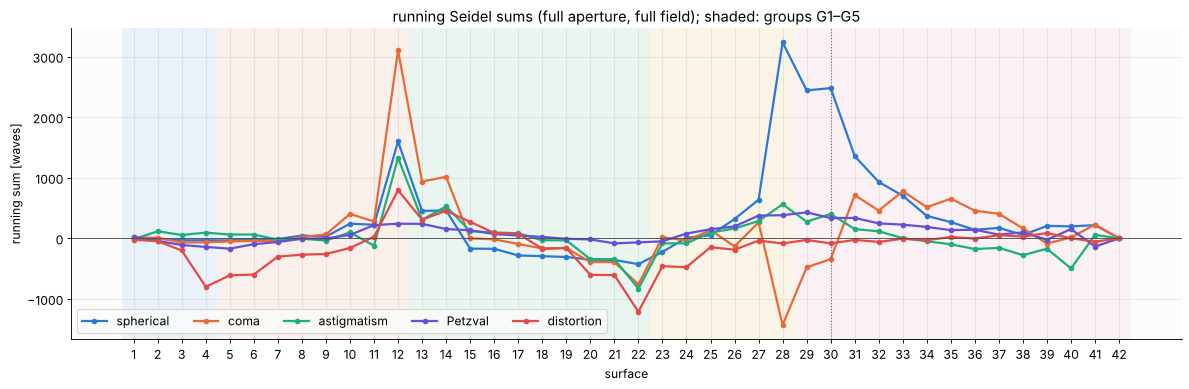
The running sum of the contributions after each surface shows how far the correction drifts inside the lens. For spherical aberration and coma it swings by thousands of waves and comes back to a few waves at the last surface.
fig, ax = plt.subplots(figsize=(15, 5))
cols = ["#2a78d6", "#eb6834", "#1baf7a", "#6250d6", "#e34948"]
for j in range(5):
    ax.plot(idx, np.cumsum(Wsurf[:, j]), "-o", ms=4, lw=2, color=cols[j], label=names[j].split("  ")[0])
ax.axhline(0, color="0.3", lw=0.8)
ax.axvline(lens.stop_index + 1, color="0.4", ls=":", lw=1)
for g, (name, e0, e1) in enumerate(GROUPS):
    ax.axvspan(els[e0][0] + 0.5, els[e1][1] + 1.5, color=COLORS[g], alpha=0.08, lw=0)
ax.set_xlabel("surface")
ax.set_ylabel("running sum [waves]")
ax.set_xticks(idx)
ax.legend(ncol=5, loc="lower left")
ax.set_title("running Seidel sums (full aperture, full field); shaded: groups G1–G5")
fig.tight_layout()
4. Seidel sums and real rays
The Seidel sums are of the order of a wave, while the real lens is corrected to a few hundredths of a wave. The residual third order is not a defect of the design: it is balanced against the fifth and higher orders, which a lens with such large single contributions has in abundance. On axis the third order spherical aberration \(W_{040}\rho^4\) of the Seidel sum is cancelled by higher orders of the real wavefront:
fig, axes = plt.subplots(1, 2, figsize=(15, 4.6))
rho = np.linspace(0, 1, 101)
for ax, fr in zip(axes, (0.0, 1.0)):
    field = fr*lens.max_field
    m = lens.opd(field, 65)
    W = m.W
    j = np.argmin(abs(m.px))
    ok = np.isfinite(W[:, j])
    ax.plot(m.py[ok], W[ok, j], "-", lw=2, color="#2a78d6", label="real rays, tangential section")
    s_ = lens.seidel(field) if fr > 0 else lens.seidel(1e-9*lens.max_field)
    py = m.py
    W3 = s_.W040*py**4 + s_.W131*py**3 + (s_.W222 + s_.W220)*py**2
    ax.plot(py, W3, "--", lw=2, color="#eb6834",
            label="Seidel (third order) prediction")
    ax.set_xlabel("pupil coordinate $P_y$")
    ax.set_ylabel("OPD [waves]")
    ax.set_title(f"field {fr:.0%}: rms {lens.rms_opd(field):.3f} waves (real rays)")
    ax.legend()
fig.tight_layout()
z = lens.zernike(0.0, n_terms=16)
print(f"on axis: Seidel W040 = {sd.W040:.3f} waves; real rays: Z9 = {z[8]:.3f}, Z16 = {z[15]:.3f} waves (Fringe)")
on axis: Seidel W040 = 0.379 waves; real rays: Z9 = -0.062, Z16 = -0.022 waves (Fringe)
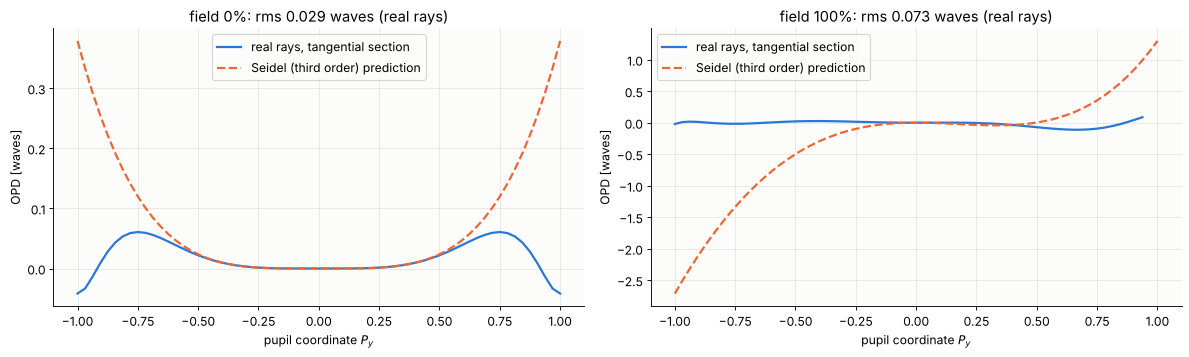
At the edge of the field the Seidel prediction (spherical aberration, coma, astigmatism and field curvature; the tilt from distortion is not part of the OPD) misses the real wavefront by up to 2.7 waves, almost 40 times the real rms error. In a tense lens the third order sums are only the starting point. The final balance is set with real rays (here by Caldwell’s optimisation), and the higher orders are as large as the third.
5. Tension: large terms that cancel
A simple measure of the tension of the correction is the ratio of the sum of the magnitudes of the contributions to the magnitude of their sum. For a relaxed design the ratio is a few. Here it is in the thousands:
def tension(system):
    s_ = system.seidel()
    return np.abs(s_.S).sum(axis=0)/np.abs(s_.total)

# a relaxed reference: a cemented achromat at F/8, 2 deg field
achromat = rt.System([rt.Surface(61.0, 6.0, material=(1.5168, 64.17), semi_diameter=6.25),
                      rt.Surface(-43.5, 2.5, material=(1.6200, 36.37)),
                      rt.Surface(-130.0, 97.0, n_after=1.0)], 0, 0.55e-3,
                     field_angle=np.radians(2.0)).at_paraxial_focus()
labels = ["S_I", "S_II", "S_III", "S_IV", "S_V"]
print(f"{'':10s}" + "".join(f"{l:>9s}" for l in labels))
print(f"{'achromat':10s}" + "".join(f"{v:9.1f}" for v in tension(achromat)))
print(f"{'Caldwell':10s}" + "".join(f"{v:9.0f}" for v in tension(lens)))
                S_I     S_II    S_III     S_IV      S_V
achromat        4.5      8.3      1.2      1.3     13.7
Caldwell      29444     7652    14108    13479    18836
The sum of the magnitudes of the contributions is what a perturbation sees. A small error in a surface changes its contributions by a fraction of themselves, and since the large contributions are no longer balanced, the change shows up in full. Two examples follow.
Radius errors. A relative radius error of \(10^{-4}\) on a single surface (e.g. 8 µm on R = −82 mm) changes the Seidel spherical aberration by up to a quarter wave:
dW040 = np.zeros(n_surf)
for i in range(n_surf):
    other = lens.copy()
    other.surfaces[i].R *= 1 + 1e-4
    dW040[i] = other.seidel().W040 - sd.W040

fig, ax = plt.subplots(figsize=(15, 4.2))
ax.bar(idx, dW040, color=surf_color, width=0.75)
ax.axhline(0, color="0.3", lw=0.8)
ax.set_xlabel("surface")
ax.set_ylabel("ΔW040 [waves]")
ax.set_xticks(idx)
ax.set_title("change of the third order spherical aberration for ΔR/R = 1e-4 of one surface")
fig.tight_layout()
for i in np.argsort(-np.abs(dW040))[:5]:
    print(f"surface {i + 1:2d}: R = {lens.surfaces[i].R:8.1f} mm, y = {ym[i]:5.1f} mm, ΔW040 = {dW040[i]:+.3f} waves")
surface 32: R =   -146.7 mm, y =  80.9 mm, ΔW040 = +0.272 waves
surface 30: R =   -142.5 mm, y =  69.9 mm, ΔW040 = -0.259 waves
surface 14: R =   -156.8 mm, y =  52.6 mm, ΔW040 = -0.153 waves
surface 11: R =    -82.3 mm, y =  34.3 mm, ΔW040 = +0.136 waves
surface 39: R =    109.0 mm, y =  68.8 mm, ΔW040 = -0.130 waves
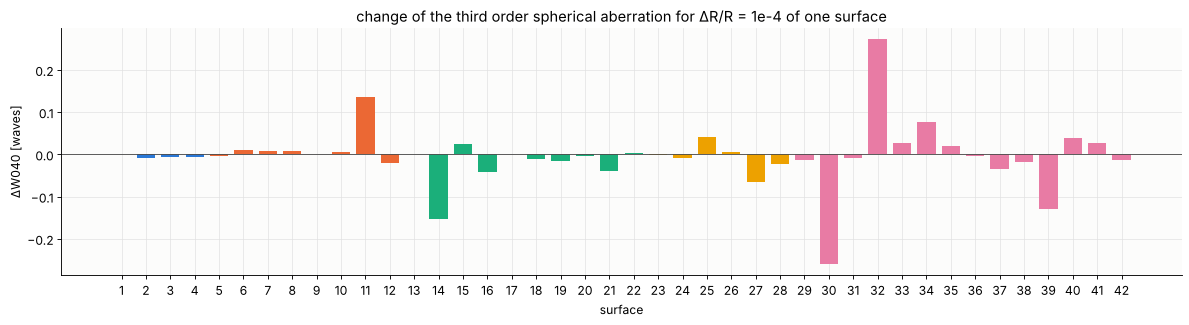
The most sensitive surfaces are not the ones with the largest own terms. They are the strongly curved surfaces at large ray height: 30 and 32 next to the stop, 11 in front of the first air lens, and 14 and 39. Changing their radius changes their power, so the marginal ray reaches every following surface at a slightly different height and angle. All the large terms downstream, up to 2600 waves each, then change by a small fraction, and the fractions no longer cancel. In a relaxed lens the same small fractions of small terms would not matter.
Decentred elements. A decentred surface is the centred surface turned about its centre of curvature. For the axial beam it acts as if it had a field: the axis ray meets it at the height \(\bar y = -\delta\) relative to its own axis, so \(\bar A = -n c\,\delta\). By \(S_{II} = (\bar A/A) S_I\) the surface converts part of its own spherical aberration into coma on axis, which no other surface compensates (Hopkins and Tiziani 1966). Each element decentred by 5 µm, traced with real rays, and the local estimate \(\Delta W_{131} = S_I\,n c\,\delta/(2A)\) summed over the element’s surfaces:
delta = 0.005  # mm
z0_ = lens.zernike(0.0, n_terms=9)
coma_real = np.zeros(len(els))
for k, (a, b) in enumerate(els):
    other = lens.copy()
    for i in range(a, b + 1):
        other.surfaces[i].decenter = (0.0, delta)
    coma_real[k] = 3*(other.zernike(0.0, n_terms=9)[7] - z0_[7])  # W131 = 3*Z8 (Fringe)

n_s = lens.n*lens.sigma
(_, u0), _ = lens._paraxial_rays()
u_in = np.concatenate([[u0], p.marginal[:-1, 1]])
coma_est = np.zeros(len(els))
for k, (a, b) in enumerate(els):
    for i in range(a, b + 1):
        c = lens.surfaces[i].c
        A = n_s[i]*(u_in[i] + ym[i]*c)
        coma_est[k] += sd.S[i, 0]*n_s[i]*c*delta/(2*A)/WL

fig, axes = plt.subplots(1, 2, figsize=(15, 4.4))
w = 0.38
axes[0].bar(e_idx - w/2, coma_real, w, color="#2a78d6", label="real rays")
axes[0].bar(e_idx + w/2, coma_est, w, color="#eb6834", label="local estimate from S_I")
axes[0].axhline(0, color="0.3", lw=0.8)
axes[0].set_xticks(e_idx)
axes[0].set_xlabel("element (decentred by 5 µm)")
axes[0].set_ylabel("axial coma W131 [waves]")
axes[0].legend()
axes[0].set_title("decentre sensitivity of the elements")
axes[1].plot(coma_est, coma_real, "o", ms=8, color="#2a78d6", mec="white")
lim = 1.1*np.max(np.abs(np.r_[coma_real, coma_est]))
axes[1].plot([-lim, lim], [-lim, lim], color="0.5", lw=1)
axes[1].set_xlabel("local estimate [waves]")
axes[1].set_ylabel("real rays [waves]")
axes[1].set_title(f"correlation {np.corrcoef(coma_est, coma_real)[0, 1]:.2f}")
fig.tight_layout()
for k in np.argsort(-np.abs(coma_real))[:4]:
    a, b = els[k]
    print(f"element {k + 1:2d} (surfaces {a + 1}-{b + 1}): {coma_real[k]:+.3f} waves coma per 5 µm")
element 15 (surfaces 29-30): -0.394 waves coma per 5 µm
element 16 (surfaces 31-32): +0.372 waves coma per 5 µm
element 17 (surfaces 33-34): +0.307 waves coma per 5 µm
element 14 (surfaces 27-28): -0.277 waves coma per 5 µm
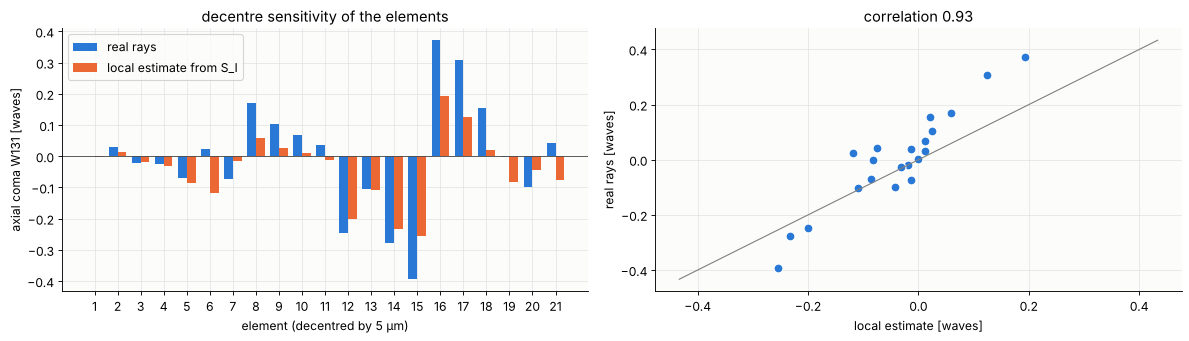
The estimate explains most of the real result. It leaves out that the beam leaving a decentred element is tilted and meets the following surfaces slightly off axis, which roughly doubles the coma of elements 16 to 18. The elements around the second air lens and the stop (12, 14, 15, 16, 17), which carry the largest spherical aberration terms, have to be centred best: 5 µm give 0.25 to 0.4 waves of coma, several times the whole design residual. This is what the tension of a correction costs, and why lithography lenses are built with micrometre centring, adjusted on the assembled lens, and corrected afterwards with manipulator and compensator elements.
Lowering the tension (more elements, aspheres, a less extreme form) is a design goal in its own right. Desensitised lens design adds the sum of magnitudes, or directly the decentre sensitivities, to the merit function.
6. Colour: what one glass cannot correct
For a thin lens, \(C_I = y^2\varphi/V\): axial colour has the sign of the power
and grows with \(y^2\). In an all fused silica lens every element has the same
\(V\), and the positive groups that make the power are also the ones at large
\(y\). The waists cannot cancel the colour as they cancel the Petzval sum.
chromatic_seidel() gives the terms for a band of 1 pm:
dl = 1e-9  # 1 pm in mm
cs = lens.chromatic_seidel(dl)
fig, ax = plt.subplots(figsize=(15, 4))
ax.bar(idx - 0.2, cs.C[:, 0], 0.4, color="#2a78d6", label="C_I (axial)")
ax.bar(idx + 0.2, cs.C[:, 1], 0.4, color="#eb6834", label="C_II (lateral)")
ax.axhline(0, color="0.3", lw=0.8)
ax.set_xticks(idx)
ax.set_xlabel("surface")
ax.set_ylabel("mm")
ax.legend()
ax.set_title("primary colour per surface, 1 pm band")
fig.tight_layout()
print(f"axial colour {1e6*cs.axial:.0f} nm per pm, lateral colour {1e6*cs.lateral:.1f} nm per pm at the edge of the field")
print(f"tension of C_I: {np.abs(cs.C[:, 0]).sum()/abs(cs.total[0]):.1f}, of C_II: {np.abs(cs.C[:, 1]).sum()/abs(cs.total[1]):.1f}")
axial colour -241 nm per pm, lateral colour -11.8 nm per pm at the edge of the field
tension of C_I: 2.6, of C_II: 14.6
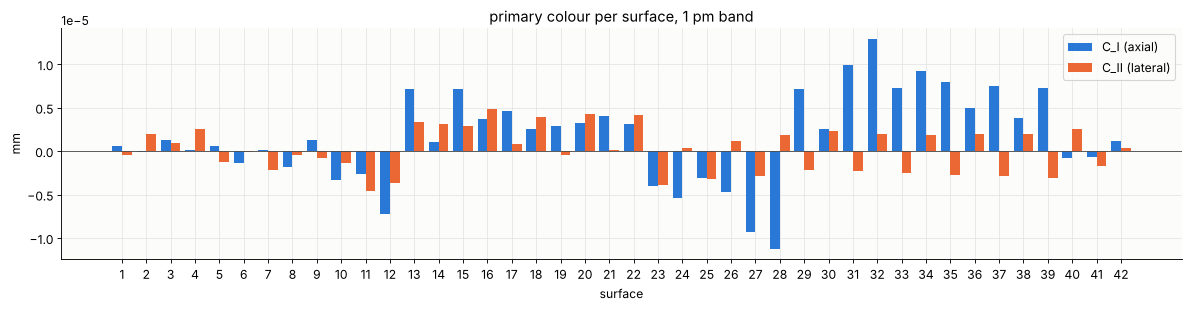
The axial colour of about 0.24 µm per pm is uncorrected. Its tension is only 2.6, because the negative elements cancel less than half of what the positive ones add. The depth of focus is \(\lambda/\mathrm{NA}^2 \approx 0.8\) µm, so the laser has to be line narrowed to a fraction of a picometre. The lateral colour, which changes sign with \(\bar y\), is balanced between front and rear (the symmetry principle again) and stays small.
Summary
The pyoptics
Systemcomputes the Seidel terms of every surface, their wavefront coefficients and their aspheric parts (seidel()), the powers of the lens, surfaces and elements (power(),surface_powers(),element_powers()), the share of each surface in the power (power_contributions()), the Petzval sum and the third order image surfaces and distortion (third_order()), and the primary colour (chromatic_seidel()).In Caldwell’s lens the positive groups produce the power and the undercorrected spherical aberration. The negative waists flatten the field (Petzval sum). The two air lenses behind the strongest negative elements (surfaces 12/13 and 28/29), where the marginal ray is steepest, provide the overcorrection that balances the spherical aberration. Coma, distortion and lateral colour are balanced across the stop. Distortion is controlled mostly by the front groups G1 and G2, where the chief ray is high.
The correction is tense: the terms are thousands of times larger than their sums, and the third order residuals are balanced against higher orders. The same large terms make the lens sensitive to radius errors and decentres (up to 0.4 waves of coma from a 5 µm decentre of one element).
Axial colour cannot be corrected with one glass: 0.24 µm per pm.
print(f"run time {time.time() - t_start:.0f} s")
run time 8 s
References
W. T. Welford, Aberrations of Optical Systems, Adam Hilger (1986) (Seidel sums, Petzval surface, primary colour).
R. Kingslake and R. B. Johnson, Lens Design Fundamentals, 2nd ed., Academic Press (2010) (thin lens contributions, symmetry principle).
H. H. Hopkins, Wave Theory of Aberrations, Clarendon Press (1950).
H. H. Hopkins and H. J. Tiziani, “A theoretical and experimental study of lens centring errors and their influence on optical image quality”, Br. J. Appl. Phys. 17, 33-54 (1966).
J. B. Caldwell, “All-fused-silica 248-nm lithographic projection lens”, Optics & Photonics News 9(11), 40-41 (1998).
T. Matsuyama, Y. Ohmura and D. M. Williamson, “The lithographic lens: its history and evolution”, Proc. SPIE 6154, 615403 (2006).